Login or Register

Join us! Members can connect with each other, post on the forum, upload pictures and receive the latest news. All are welcome!


Who's Online

We have 3 guests online

Welcome

SacramentoDiscGolf.com was created as a resource for Sacramento Disc Golfers of all ages to learn about Disc Golf, and to share enthusiam about the sport.  It is my hope that you will find benefit in this site. 

Disc golf (sometimes called Frisbee golf, or frolf) is a disc game in which individual players throw a flying disc into a basket or at a target. According to the Professional Disc Golf Association, "The object of the game is to traverse a course from beginning to end in the fewest number of throws of the disc."

DiscGolf4-G_Widman_UnitsDisc golf is similar to traditional golf and uses much of the same rules and terminology. As in ball golf, a course usually consists of 18 holes. Unlike ball golf, most courses are located in public parks and are free to play, although some courses require a nominal fee, and the sport requires inexpensive discs instead of costly clubs and balls. The modern disc golf target consists of a metal basket with chains hanging over it and was invented in 1976. 

There are several nice Disc Golf courses in the Sacramento Area, and if you yet have to play I encourage you to try it soon.

Rules of the Game

Rules

When teeing off, you should not cross the front of the tee until you have released the disc.

All subsequent throws should be played from where the previous throw landed. It is common to use a 'mini' disc to mark your lie. Your foot should be no more than 30 cms behind your mark, perpendicular to the target, when you release your throw.

Fairway run-ups are permitted, however, you should take care to stay behind your mark.

The disc farthest from the target, throws first.

Falling putts are not permitted within a 10 meter circle of the target. Full balance on the putt within 10 meters must be attained.

The hole is complete, when the target is hit, or, when baskets are used, when the disc comes to rest, supported by the basket or chain mechanism. Current PDGA rules do not count discs which land on top of the basket.

Current PDGA rules declare any disc which is above 2 meters, say in a tree, as Out of Bounds, and a one stroke penalty is incurred, taking your next shot from the point directly below where the disc is vertically elevated.

If your disc goes in a marked out of bounds spot, take a penalty shot and play the shot where it went out.

Disc Terminology

*Note* All statements will be made assuming a right-handed backhand (RHBH) throw. Left-handed backhand and right-handed forehand throws will result in a flight path opposite of the ones described here.

  • Hyzer - Releasing the disc with the outter edge at an angle lower than parallel to the ground. This will cause the most discs to curve to the left.
  • Anhyzer - Releasing the disc with the outter edge at an higher than parallel to the ground. This will cause the most discs to curve to the right.
  • High Speed Turn - The characteristic of a disc to curve to the right at the beginning of its flight when thrown hard.
  • Low Speed Fade - The natural tendency of a disc to tail left as it slows down at the end of its flight.
  • Overstable - A term used to describe the relative resistance to high speed turn and amount of low speed fade of a disc. A more overstable disc will generally have higher resistance to turn and greater low speed fade.
  • Understable - A term used to describe a disc with relatively low resistance to high speed turn and less low speed fade.
  • Turnover - The term used to describe the flight of a disc that curves to the right when thrown flat or at hyzer. A less overstable or understable disc will generally be easier to turn over.
  • Nose Down - Releasing the disc with the front end of the disc lower than the back end. Certain discs will fly better when thrown nose down.
  • Nose Up - Releasing the disc with the front end of the disc higher than the back end.
  • Stall Out - A term used to describe the flight of a disc when it peaks in height and drops off to the left without much glide. This generally occurs when the disc is thrown with the nose up.
  • S-Curve - A term used to describe the flight of a disc when it begins by turning to the right and then "flexes" out and glides back to the left.
  • Roller - A type of throw where the disc is turned over so far that it lands on its edge and rolls.
  • Snap - A term used to describe the armspeed and power a player gets into their throw. More snap will generally make the disc fly faster and further.

Technique

Technique

This is the most common problem for beginners. This may or may not be a problem with your disc. If you have an understable disc you just need to learn to throw harder, or use more of an anhyzer release angle. If you have an overstable disc, and changing the release angle or speed of shot does not help, you may need to buy a more understable disc.

dg101grips


Q. My disc always turns over. What do I do?
If you have this problem you are doing one of two things wrong. First make sure you are not throwing with to large of an anhyzer angle. If this does not work your disc is probably too understable for the speed of your throw. You probably need a more overstable disc. If you are already using an overstable disc, try a larger hyzer release angle even when you don't want the disc to turn. For players who throw really hard, or throw forehand, an even more overstable disc may be needed.

Driving

Grip
Gripping the disc happens before you even step up to throw. There are some general rules of grip, although later on in your game you may feel the need to modify it, here are a few basic tips to get you started. You should be using a grip that has all 4 fingers under the disc. Your grip should be firm and the disc should rip out of your hand rather than slip out. If you are trying to let go of the disc, a consistent release is near impossible. Your grip should be loose enough to let your forearm and wrist move freely before the disc rips out. When people talk about a very tight grip they are referring to tightening the grip right when the disc should rip out of your hand. Your thumb should as close to the edge of the disc as possible while still being over the soft part of the disc.

Footwork
Footwork and balance will dictate the success and failure of your throw. If you are off balance and have a poor center of gravity a consistent and accurate throw will be very difficult to achieve without compensating in other ways. While it is possible to do, the most efficient techniques are those with good balance throughout the throw. You should be throwing with the X-step. If you use an extra run-up or stutter step, the X-step will be the last 3 steps of your throw. Try to stay light, quick, and smooth on your feet. Heavy steps will lead to mistiming and make shifting your weight more difficult. Make sure you get your weight over your front foot when you plant and start your throw. If your weight is behind your foot it will affect your throw in negative ways and also risk injuries to your knee and ankle. Use the explosion of your hips to start your body rotation. The direction of your feet will lead your hips, your hips will turn your torso, your torso will turn your shoulders, and your shoulders will lead your arm.

Reach Back
There are mixed philosophies on the reach back part of your throw. There are however a few things that are consistent between the various techniques. Your reach should only be as far as you feel comfortable with and can maintain good balance. You should reach in a straight line rather than swinging the disc back on an arc. You should also plan your intended throw during this time. For a flat line drive your hand should be on the same plane as the disc. For a hyzer, your hand should be under the disc and for an anhyzer, your hand should be above the disc.

Pull Through
The pull-through is where you begin to generate the power needed for a long throw. For maximum power and speed your shoulder rotation should pull your arm through. Don't try to muscle or “strong arm” the disc it won't be nearly as powerful or fast as a whip driven by the shoulders. Also, keep the disc as close to your chest as possible and let your elbow bend. The extension of your elbow during the latter part of your throw will be your main power source. You should also have your off arm close to your body during the throw in order to let your body rotate as fast as possible. Also of importance, try to be as strong as possible at the point the disc will leave your hand rather than at the beginning of your throw. This should give you maximum snap as the power is focused on getting the most force on the disc at the release rather than during the pull.

Follow-Through
A good follow-through is important for both a clean throw and to avoid injury. Although you should be smooth and loose during the first part of your throw, concentrate on finishing strong during your follow-through. A clean pivot is also good to avoid knee injury, as your body will continue rotating after the disc leaves your hand.

Disc Selection
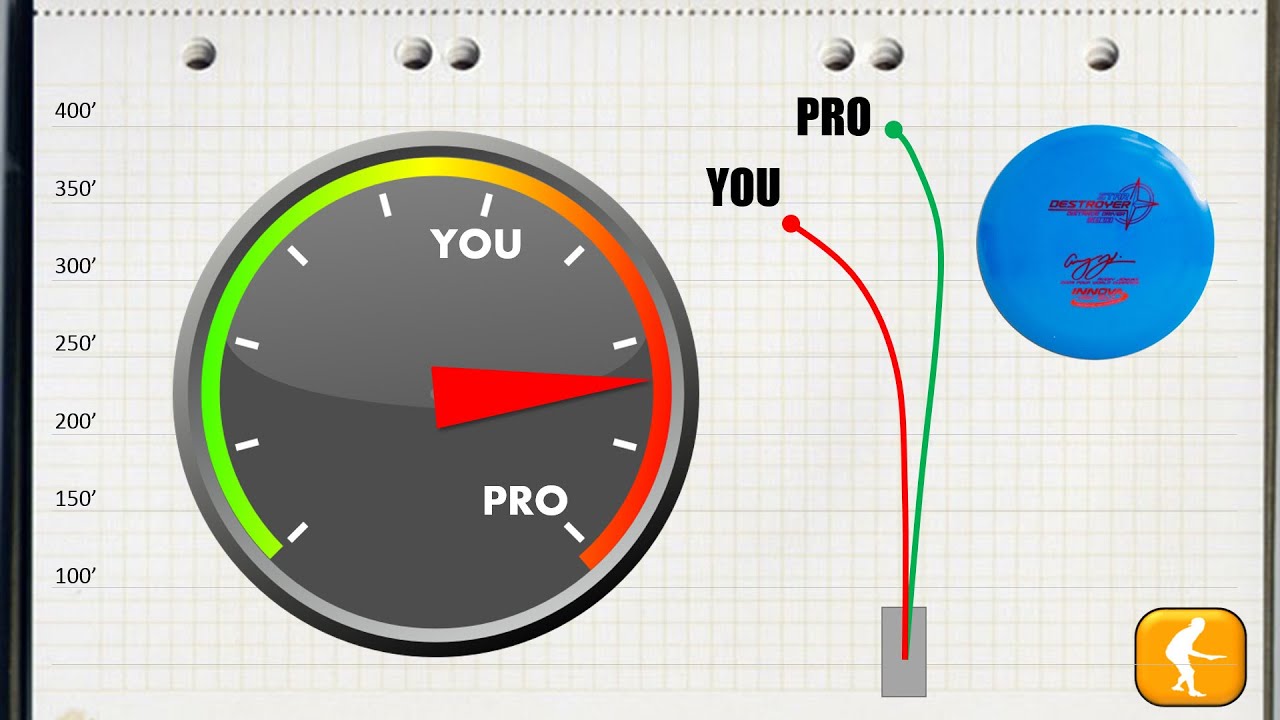
Disc selection is also a very important part of your game. Make sure you are throwing discs that are light enough and easy enough for you to control. Most of the modern “ultra long” drivers are designed with the pro player in mind. Most new players will have the best success with discs that are easy to control and have good glide and discs under 170 grams in weight. A rule of thumb is if your average distance is less than 200' you will probably have the most success with the larger diameter all-around midrange discs and drivers. If you can throw 200-250' on average the easier to control small-diameter drivers should be within your range of control. Once you can throw 250'+ you will be in a better position to control the faster overstable maximum distance drivers.

Midrange

Throw every shot firm. If you are slow and soft a consistent release will be more difficult. Shorten up and use less body rotation on shorter shots rather than throwing softer.

Don't try to overpower midrange discs. Long throws with a midrange are achieved through finesse, quickness, and a solid finish instead of raw power. Too much strength will turn over midrange discs.

Aim just short and slightly to the right of your target (for RHBH throws). The disc will curl to the left and slide/skip a little. Play this knowledge to your advantage.

If you are outside of your realistic make range, your goal should be for a drop-in putt. Although spectacular when it goes in, running at the chains from a long ways out is an easy way to lose a stroke by leaving you with a difficult comeback putt.

Throw your slowest/shortest disc that can get you to your desired target. This is the same idea as hitting a 9-iron vs. choking up on a 5-iron. Slower and shorter discs are more accurate than longer, faster discs. Use whatever can get you there with the most consistency and accuracy (this will often be your putter).

Putting

Try to putt with the disc flat or nose down and go for a lofting up and down arcing flight path. This line is advantageous vs. a line drive putt by reducing the fly by distance of misses.

Learn to play the wind. Headwinds make the disc rise while tailwinds make the disc drop faster. Practicing your putt when its windy out will help you gauge the angles and trajectories you need for success in the wind.

Don't try to muscle your putts. The power for a putt is generated by a weight shift forward. On longer putts try to get more of a weight shift. Your putting motion should be quick. Slower motions can be inconsistent and have a tendency to putt low if you are afraid of missing. You want a form that is consistent and that you can repeat again and again.

Use the spring of your fingers to your advantage. Springing your fingers off the disc (like throwing a dart) will give you a clean release and generate enough spin on the disc to keep it from wobbling.

Putt how you practice and practice how you putt. If you spend a lot of time lining up your putt and focusing when you throw a round, do not rapid-fire putt during practice. If you prefer to rapid-fire putt during practice, do not spend too much time lining up your putt when you throw a round. Putting differently will cause changes in your putting stroke between practice and the round. Know your putt and try to feel it with every throw.

Know when the smart play is to lay up. Long putts are great when they go in but can be a nightmare if you miss. If your 50% make range is 25', don't run at the chains from 50' if you will leave yourself with a comeback putt longer than 25'. Play smart and know the right time to go for it.

DG Courses

Sacramento Area Disc Golf Courses:

Elk Grove Disc Golf Center

Landscape / Terrain: Mostly Flat & Lightly Wooded
Holes: 9
Length: 2489 ft
Multiple Tees/Pins: no/no
Tee Type: concrete
Hole Type: mach 3
Description: Flat and open with trees & OB near half the holes. Unplayable 1st weekends in May and Oct. Playground, BBQs, fishing, dog park, horseshoe pits, and swimming pool.
Zip Code: 95624
Location Directions: Hwy 99; exit Elk Grove Blvd. Go east a mile to a right on Elk Grove-Florin Rd., 1 mile to a right into Elk Grove Regional Park (just after the high school). 1st left into parking lot. 1st tee down path on east side of the pool.


John Mackey Park

Landscape / Terrain: Mostly Flat & Lightly Wooded
Holes: 9
Length: 2900 ft
Multiple Tees/Pins: no/no
Tee Type: concrete
Hole Type: mach 3
Description: Nice urban course. Slight undulations and a handful of giant oaks. Weekly doubles are on Monday evenings at 6pm throughout the summer.
Zip Code: 95815
Location Directions: Business 80 to Marconi Ave. exit. Go west to a right on Kenwood St. 1st tee just past playground.


Regency Community Park

Landscape / Terrain: Mostly Flat & Lightly Wooded
Holes: 9
Length: na
Multiple Tees/Pins: no/no
Tee Type: concrete
Hole Type: basket
Description: Family park with playgrounds, skatepark and bathrooms. Relatively flat and open with small trees. Very short course - drive with your putter. Perfect for night golf!
Zip Code: 95835
Location Directions: I-80; exit Truxel (north). Cross Del Paso Rd., right on Club Center Dr. Immediate left, follow to far side of park (past skateboard park). 1st tee by larger white sign.


Rocklin Disc Golf Center

Landscape / Terrain: Mostly Flat & Lightly Wooded
Holes: 18
Length: 5868 ft. – 6406 ft
Multiple Tees/Pins: no/yes
Tee Type: concrete
Hole Type: mach 3
Description: Excellent mix of long and medium holes meandering through mature oaks with a creek that comes into play on several holes. Multiple pins, switched frequently.
Zip Code: 95677
Location Directions: I-80 to Rocklin Rd. exit, north, left on 5th St. Johnson Springview Park is near the library on the right.


Santa Anita Park

Landscape / Terrain: Mostly Flat & Lightly Wooded
Holes: 9
Length: 1135 ft
Multiple Tees/Pins: no/no
Tee Type: grass
Hole Type: DGA
Description: Founded in 2010, this is a great place for kids or beginners since the hole lengths are shorter than average, 108 to 156 ft.
Zip Code: 95825
Location Directions: From Howe Ave., right on Cottage Way. Look for the Home Depot. Continue on Cottage Way for .2 miles to a left on Bell St. Park will be on the right in .2 miles and parking lot will be on the left. You will need to cross the street from the parking lot to get to first tee.


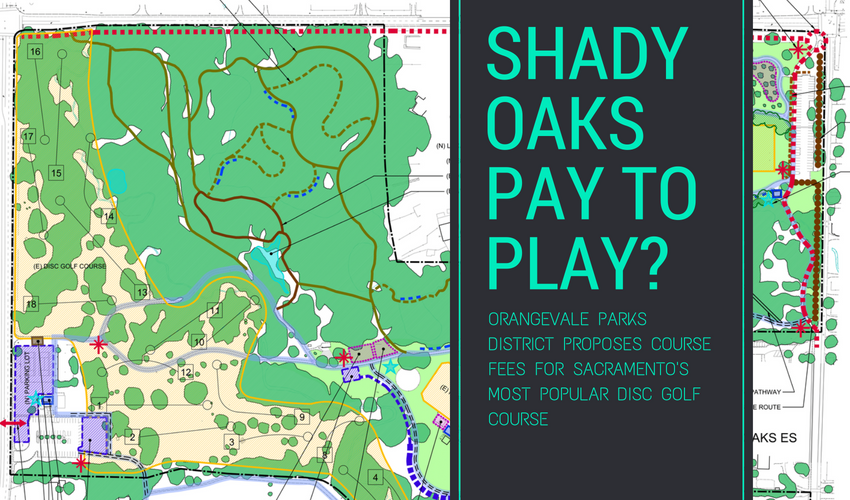
Shady Oaks

Landscape / Terrain: Mostly Flat & Moderately Wooded
Holes: 18
Length: 5652 ft
Multiple Tees/Pins: no/yes
Tee Type: concrete
Hole Type: mach 3
Description: Fun and challenging in a mature, fairly wooded, country-like setting. A small creek runs through it. Multiple pins. Pro Shop on site.
Zip Code: 95662
Location Directions: Exit Hwy 50 north on Hazel Ave. Corner of Oak Ave & Hazel Ave, enter park off Hazel.

Winter is here again, so grab your hot beverage and coat, and let's make the most of Discing in Sacramento as we prepare for the coming year!

Learn more about Disc Golf in Sacramento: 

PDGA

Frontpage: RSS

Poll

What is your favoirte Sacto Disc Golf Course?

Suggested:

Do you need a professional website developed for your Sacramento Business? Contact E. Curtis Designs to learn more, and visit our Blog for expert advice and the latest in website development tips.
http://www.ecurtisdesigns.com | E. Curtis Designs on Facebook

Photo Gallery